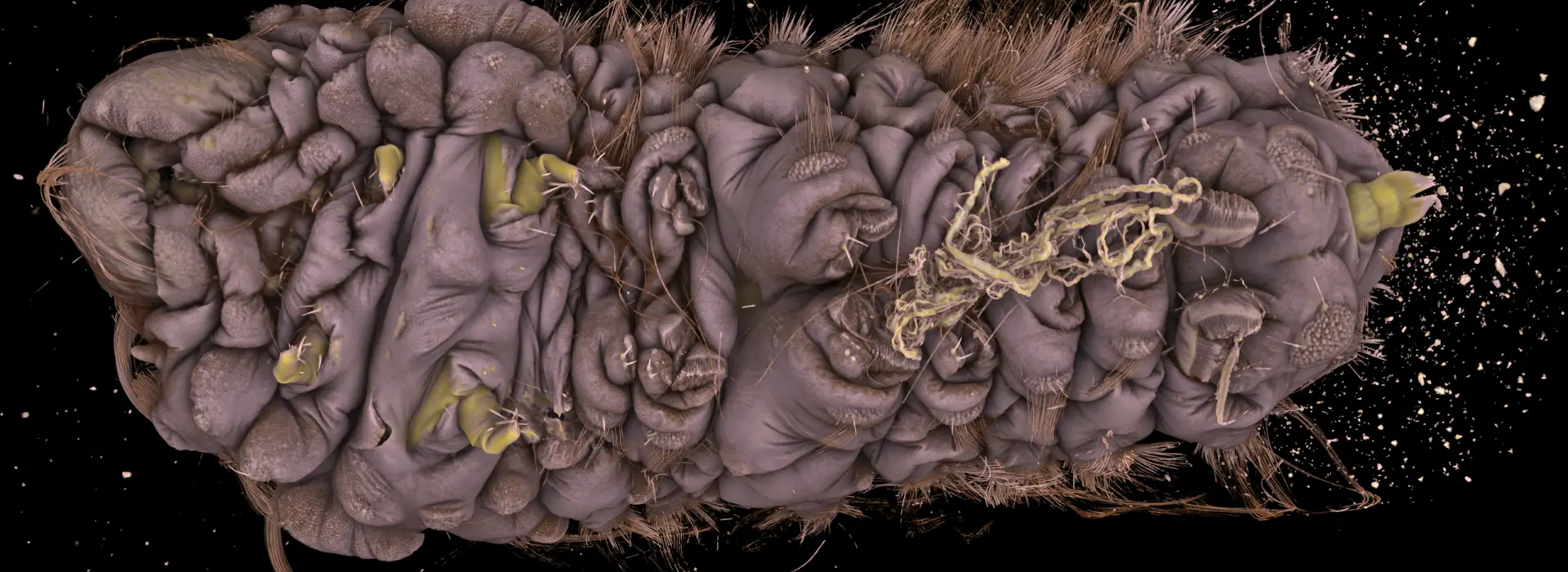
Australian Christmas Beetle (Anoplognathus)
This tomogram from CTLab formed the basis for a work of art entitled 'Christmas Beetle, (front) and Christmas Beetle, (back)' by renowned Canberra visual artist Erica Seccombe. The high-quality of the data enabled Erica to portray the virtual beetle in exquisite detail, revealing both the external and inner structures through transparency and colour. A pair of 3D renderings was printed onto mirrored surfaces to enhance the transparency of the work and create a self-reflective moment. This work seriously examines issues of visualisation, scale, replication and simulation of the natural world, and explores scientific interpretations of knowledge.
Selected Finalist, 40th Alice Art Prize, Araluen Art Centre, 2018
Specimen courtesy of the Australian Museum, Sydney
Originator: Erica Seccombe
Application: Digital Art
Affiliation: ANU School of Art & Design, Australian National University (ANU)


Small Veins of the Thumb
The image is a right thumb harvested from an 86-year-old female cadaver. Contrast agent was infused into the vascularity with a technique developed by Dr Benninger. The image has a resolution of 14 microns and is unique in mapping the small veins of the thumb, which can help inform medical procedures to reduce surgical hemorrhaging.
Work was carried out at Oregon State University MicroCT Facility using a customised Heliscan micro-CT that was built as part of a research agreement with the Department of Material Physics (formerly Applied Maths) and the CTLab at the ANU.
Specimen courtesy of Brion Benninger, MD MSc, Professor of Medical Innovation, Technology & Research , Medical Anatomy Center - COMP-Northwest, WesternU
Originator: Douglas Meisenheimer
Application: Biomedical research (Anatomy)
Affiliation: Oregon State University MicroCT Facility
Dragonfly Head
Elucidating the structure and function of insects’ organs feeds our fundamental understanding of biology and evolution across all species. The Zeil Group (Ecological neuroscience) focuses on 'the role of vision and the navigational information content of different habitats'.
This image shows the detailed structure within the head of a dragonfly. Of particular interest is the nerve fibres connecting the compound eye directly to the insect’s brain.
Originator: Willi Ribi
Affiliation: Private Universität im Fürstentum Liechtenstein (UFL) and the Research School of Biology at the Australian National University

