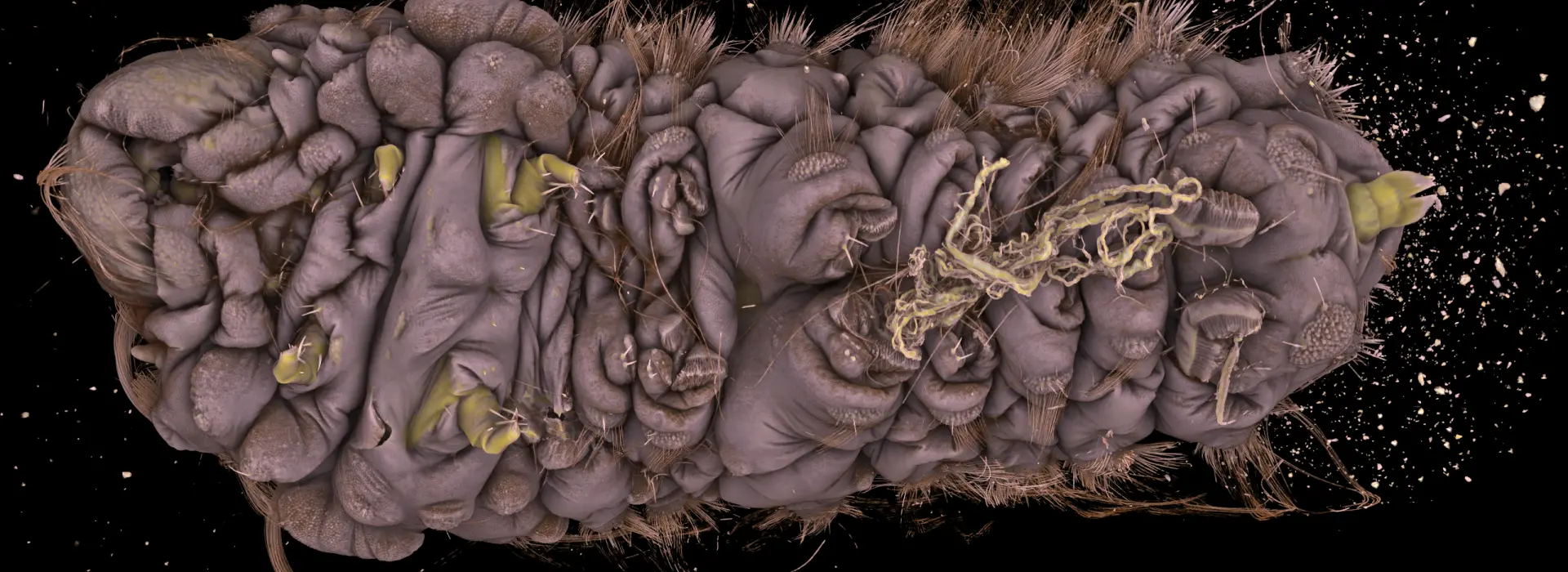
A surprisingly wide range of problems have benefited from using micro-CT imaging. Although we initially focused on studying and modelling rocks, the instrumentations and techniques we developed enable us to peer inside an amazing range of complex structures.

Geosciences
Micro-CT is a non-destructive imaging technique and a valuable tool in geosciences. It provides detailed 3D information about the internal structure, porosity and composition of various geological materials.
This high-resolution, high-quality imaging of geological samples has enabled valuable analysis in applications such as:
- Carbon Capture and Storage (CCS)
- Oil and gas exploration and recovery
- Minerals and mining

Analysis of Biological Structures
Micro-CT imaging can be used to visualise the structure of complex biological samples across a wide range of specimens. From small parasites and insects to entire animal specimens, it is possible to segment out and visualise their internal structures.

Heritage
High-resolution micro-CT is a powerful non-destructive tool for 3D analysis of cultural heritage objects. It makes it possible to examine the structure and composition of invaluable specimens without altering or damaging them. CTLab has a great tradition of assisting archeologists and palaeontologists with their research.

Modelling Complex Materials
High-resolution micro-CT enables full 3D analysis of materials with complex internal structures. It can be applied to composite or complex materials such as
- Wood
- Carbon fibre
- Textiles
- Paper

Non-destructive Testing
Due to its ability to resolve individual components within an electronic device, micro-CT is an ideal tool for non-destructive testing. It enables the investigation of failed devices before undertaking critical disassembly and can assist with determining manufacturing defects and failure mechanisms.

Additive Manufacturing QC
Micro-CT imaging can be used to visualise the 3D structure of objects created through additive manufacturing (e.g. 3D printing). This enables the identification of defects such as unwanted voids, cracks or weak spots and has critical importance for understanding and minimising these defects.