Is X-ray CT suitable for my application?
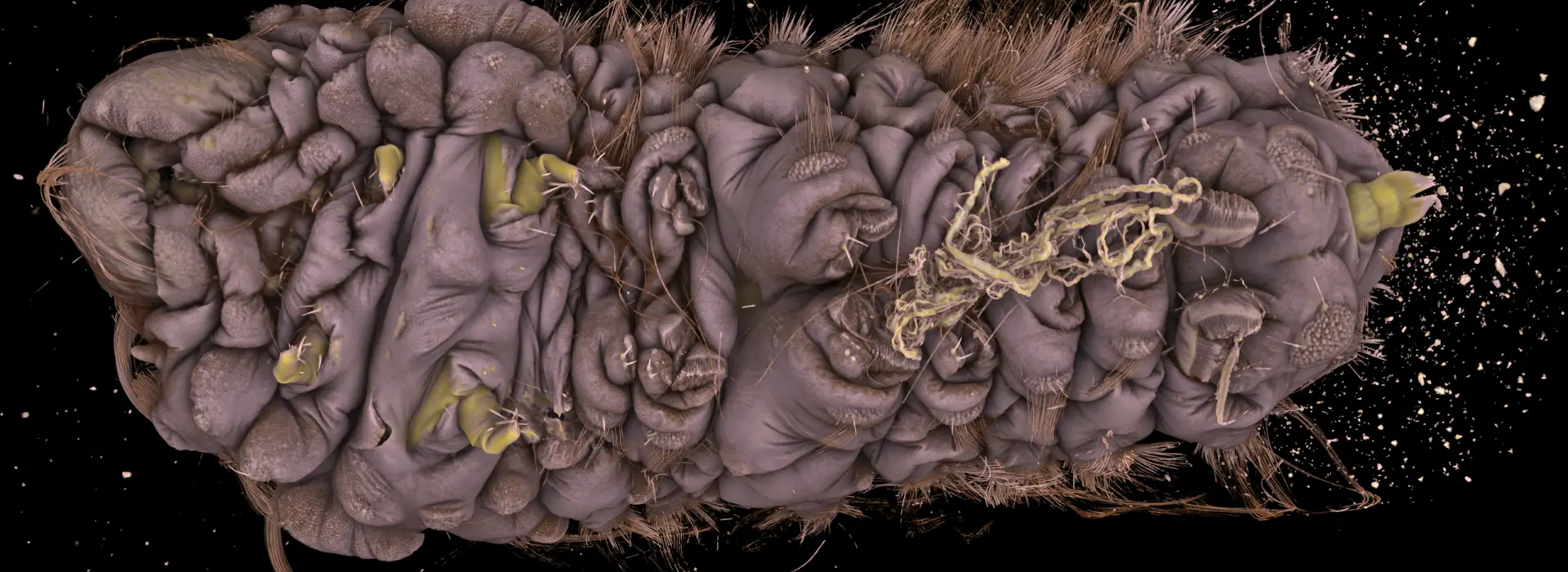
A surprisingly wide range of problems has benefited from using micro-CT. Although we focused initially on studying and modelling rocks, the instrumentation and techniques developed have enabled us to peer inside an amazing range of complex structures.
Applications include:
- Geology (including rocks for fossil fuel extraction and carbon capture and storage),
- Palaeontology (fossils from around the world),
- Archaeology (wood, plant material and artefacts),
- Material science (wood, carbon fibre, foams and other composite materials),
- Entomology (stick insects, wasps, bees' brains, flies' eyes and more),
- Parasitology (fleas, worms, etc.),
- Biological (frogs, snakes, bats and spiders)
- Bio-medical science (implants, bones, muscles and skulls).
The combination of our specialist hardware, software and experience allows us to provide valuable data even for the most technically challenging samples. If you're unsure, please don't hesitate to ask. You may be surprised, as we can often showcase examples of previous similar experiments.
What is the technology used in CTLab?
CTLab uses a suite of custom, in-house designed and built Helicscan x-ray micro-CT (Computed Tomography) systems to create 3D representations of real-world objects.
This is done by taking a series of thousands individual two-dimentsional x-ray images (radiographs) of a slowly rotating object from different points of view. These projection images are then reconstructed using our unique CT algorithm to recreate the object in 3D.
How do I acknowledge/cite CTLab?
All users of CTLab resources benefit from many years of investment, research, and development conducted within the Research School of Physics at the ANU. As a condition of access to CTLab resources at non-commercial rates, users are required to notify us of any resulting publications and to cite our work as explained on the dedicated Citations/Acknowledgement page.
How do we get from 2D to 3D?
Theoretically, the sum of the structural information contained in the many radiographs collected is sufficient to create a full 3D model (tomogram) of the sample in question. However, constructing the model requires some ingenious algorithms and a considerable amount of computing power. Fortunately, CTLab is run by the the Department of Material Physics (formerly Applied Maths), who are world-class in this field and has skillfully leveraged the computing resources of the NCI to provide elegant and workable solutions.
What is the output? Is it useful to me?
The usual output is 16-bit 3D volumetric dataset (e.g. 2500 x 2500 x 7500 pixels) in NetCDF format. The datasets can be converted to other formats (such as TIFF stack or ZARR), and they can also be downsampled as required.
Our 3D models are high resolution and geometrically accurate. Each point in the 3D model is given a 16-bit value that represents the average X-ray attenuation around that point. These large data volumes are sufficient (or even excessive) for most applications, including analytical modelling.
Scanning conditions can be tailored to your individual application.
What sizes of samples can be scanned?
We have a suite of instruments available for different sample sizes. As samples are rotated during scanning, we need to consider the size of a cylinder into which the sample can fit.
We can scan objects that fit into a cylinder of diameter < 300mm and the height <= (1200mm – diameter). For example, a rock core of 200mm diameter by 1m long cylinder would be possible to scan.


Is there anything that cannot be scanned successfully?
Yes, although the application range is very wide, there are some exceptions:
- Live animals cannot be scanned.
- Objects that move: Scans can take several hours to complete, so the sample must remain stable throughout to produce an image without blurring.
- Objects that are too X-ray attenuating: To take suitable radiographs, a portion of the X-rays must pass all the way through the sample to the detector to create an image. Problematic samples are ones containing significant thickness of high Z-number metals, e.g. lead, gold, titanium, etc. Please contact us for advice.
Is my sample changed by scanning?
In virtually all cases, the answer is ‘no’. Just like a medical X-ray or a CT scan, Micro-CT is a non-destructive technique. However, we have seen some low-level X-ray damage to plant tissues and some other substances under extreme circumstances. Don't hesitate to reach out to us to discuss your sample.
What can I do with my data?
For visualizations, it is possible to use Drishti -- free NCI's Vizlab. Dristhi can be used to create full colour, HD images, 3D animations and 3D meshes for 3D printing.
For segmentation and analysis, it is possible to use WebMango/Mango software developed at the Research School of Physics. It can be used for parallel segmentation, network generation pre and post-processing of associated data.
How much does it cost?
CTLab works on a partial cost recovery model.
Charges for non-commercial research start at $350 for a basic scan. The total cost depends on the resources required to complete your project and depend for example, on the number and size of the samples.
For further details or a detailed quote please contact us and we will be happy to help.