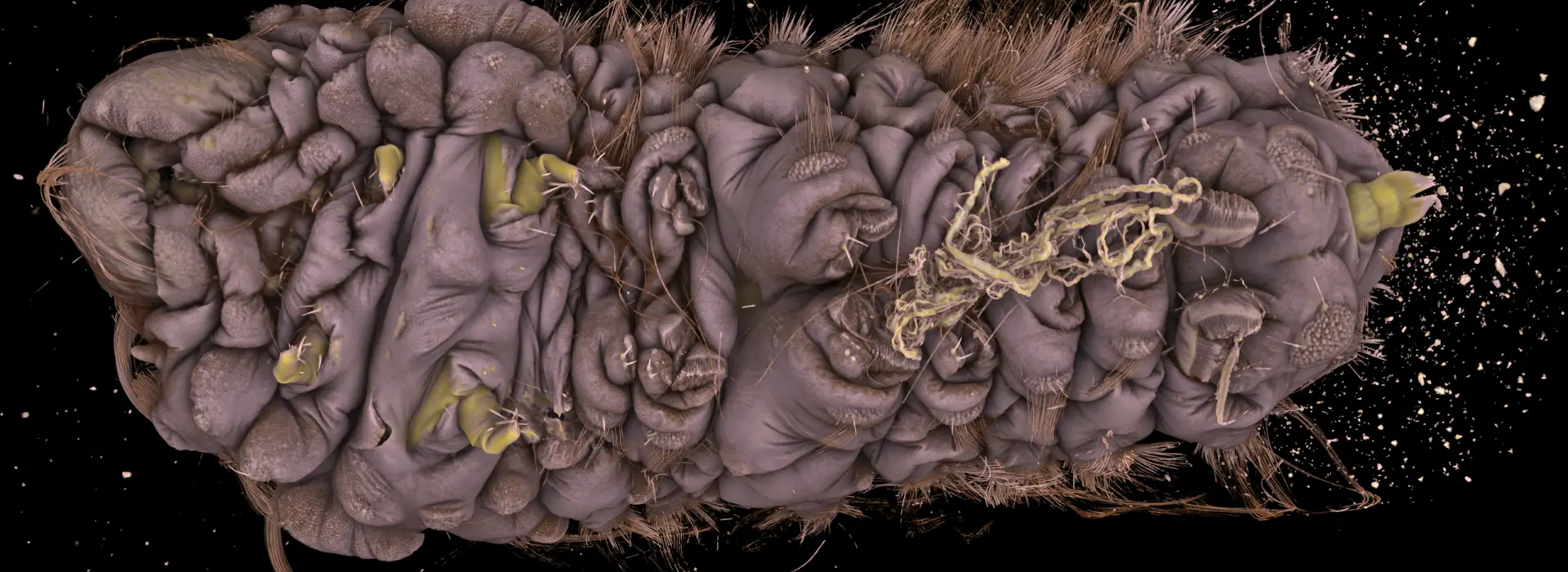
Magic Bundle
Magic bundles from Papua New Guinea were CT-scanned to determine their contents without removing delicate organic wrappings and damaging them. These bundles had been part of the ANU ethnographic collections for decades, however, their contents were previously unknown. Our scans revealed an assortment of animal bones and rocks not visible or identifiable externally.
Originator: Maggie Otto
Application: Ethnographical Collections
Affiliation: School of Archaeology and Anthropology, College of Arts and Social Science


Pottery Sherd with Rice Husks
The School of Archaeology and Anthropology has collaborated closely with the ANU CTLab to scan a diverse range of archaeological materials from their collections for several interdisciplinary research projects. Organic-tempered pottery sherds were scanned in order to study cereal remains such as rice husks within the pottery, which can help determine the domestication status of cereals and, therefore, the wider subsistence strategies and human-plant relationships of the past.
Originator: Aleese Barron
Application: Archaeobotany
Affiliation: School of Archaeology and Anthropology, College of Arts and Social Science
DOI: https://doi.org/10.1016/j.jasrep.2018.07.024
Early Devonian Arthrodire (Fossil)
High-resolution non-destructive analysis of specimens that may be over 400 million years old is highly desirable. The expertise and techniques that have been developed for analysing geological samples can be used as powerful tools to help understand the morphology of fossil specimens.
From this image (based on a high-resolution helical CT-scan), we are able to see the gnathal elements that are thought to be an important part of the early evolutionary development of alternatives to teeth. This is the articulated buchanosteid arthrodire (ANU V244), ventral view, showing the right and left posterior supragnathal and right infragnathal in situ.
Originator: Yuzhi Hu
Application: Palaeontology
Affiliation: Material Physics, Research School of Physics and Engineering (RSPE), Australian National University (ANU)


Jawbone of Australian Megafauna
Many invaluable megafauna holotype fossils have been scanned at the CTLab, including this jawbone of an extinct kangaroo species, Dendrolagus nombe, found at the Nombe Rockshelter in Papua New Guinea. Precise three-dimensional size and shape information of fossilised bones is crucial for identifying extinct species, with teeth often being the most diagnostic elements. CT scans of such megafauna fossils have been shared with researchers across Australia for complex morphological analyses, avoiding the physical transport of rare and fragile specimens.
Originator: Tim Denham
Application: Archaeology/Palaeontology
Affiliation: School of Archaeology and Anthropology, College of Arts and Social Science
DOI: https://doi.org/10.1002/arco.5274